

Disclaimer: The views expressed in this piece are solely my own and do not represent those of my employer. I wrote this piece about technology and industry dynamics for educational purposes only, not to promote any specific products or services.
Most people both undersell the true potential of personalized AI learning and underestimate how much demand this new paradigm places on students.
Every human having an on-demand learning expert in their pocket unlocks more than a mere private tutor for schoolchildren. It raises the ceiling of what anyone could learn throughout their life by letting them shape a curriculum around their needs and wants.
However, realizing this potential requires most people to design effective learning goals and exercises for themselves for the first time. Schools do not train this in people - mass education generally makes student-led curriculum and lesson design impractical. AI has the know-how to design an effective curriculum and lesson, but it requires learners to specify what they want to learn and what is in their way (at least until we have sufficiently capable Neuralink).
I lost hundreds of hours to avoidable mistakes doing this for the first time learning Mandarin on my own. In June I wrote about the generalizable lessons I took from using AI to build a platform for studying Mandarin, and here I want to share the generalizable lessons I took from studying Mandarin with that AI-powered platform so you don’t need to lose the time I did.
1. Define Goals That Clarify Priorities
I wrote in the June piece that clearly specified goals help you get more from AI. Since then I learned that a clear goal is only effective if it clarifies your priorities.
I have had a north star since I started learning Mandarin in mid-2020 that describes exactly where I want to get to - “to be able to read Chinese history books unassisted and have a conversation about them with a native speaker.”
But this statement actively worked against prioritization. Reading any arbitrary history book unassisted requires knowing ~98% of tens or hundreds of thousands of words in a book, sampled from a distribution of 100,000+ unique Chinese words. It effectively said that I had no priorities because everything was important.
Trying to learn by prioritizing everything at once was a bit like trying to train for a marathon by only doing CrossFit. CrossFit trains your general fitness, which genuinely helps, but it does not prepare you to pass the 20th mile. My version of CrossFit was trying to make flashcards from words I assembled from anywhere - textbooks, TV shows, street signs, etc. - and mostly using AI to make more flashcards faster. This meant that I was not training the specific words I needed to read native Mandarin (I dropped any book I tried to read because I could not parse it), and because I was not using the words I was trying to study in context I absorbed them more slowly.
Refocusing my near-term learning objective from reading arbitrary books to a limited set of news articles gave me the clear priorities I needed. Prioritizing words that appear most frequently aligned my practice with things I cared to know about. Because I knew what words and content to target, I could use AI to build a daily newspaper for me from free news articles and remove friction from this practice process (it automatically finds news articles I am interested in, I mouse over a word to look up the definition, click to add to flashcards).
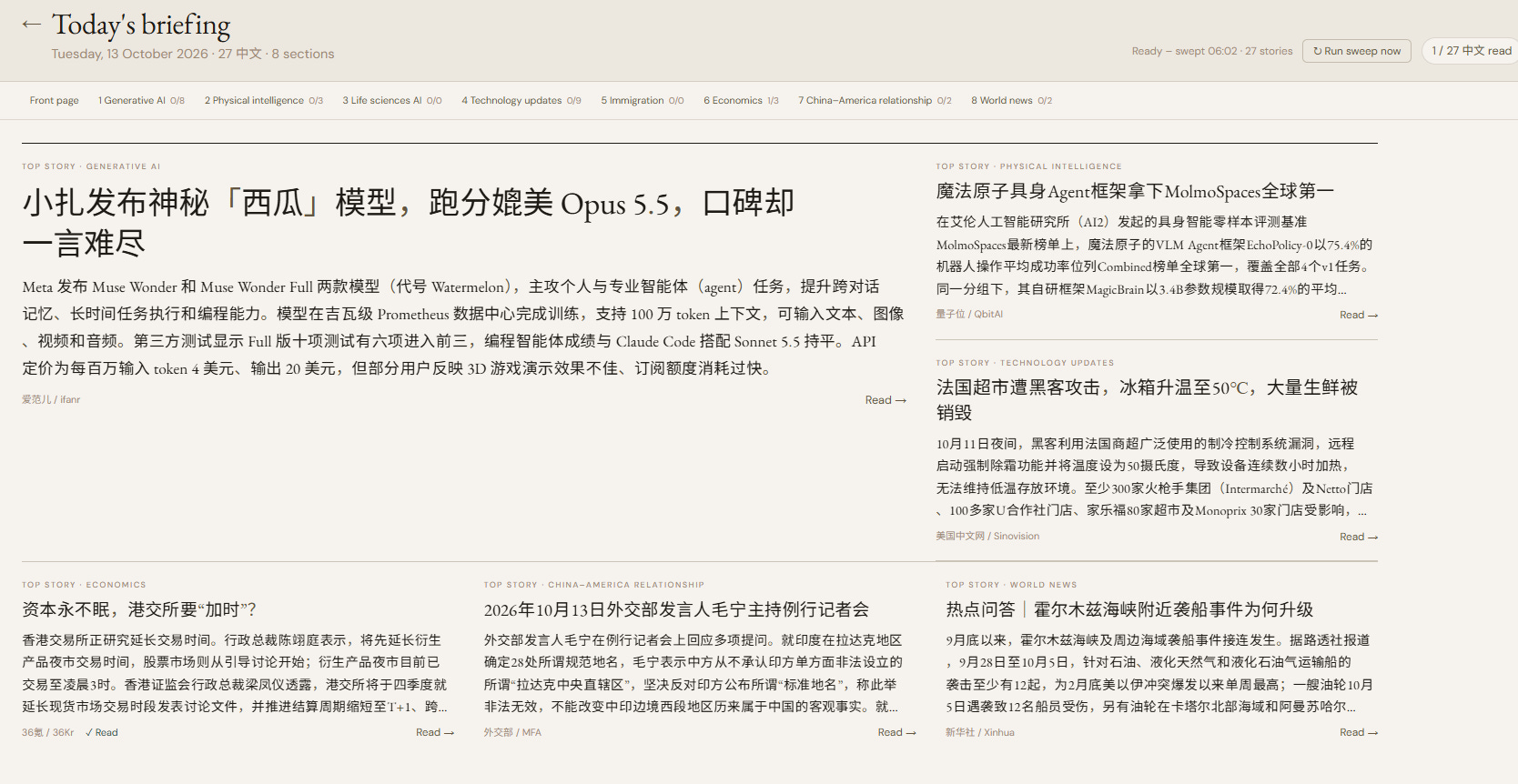
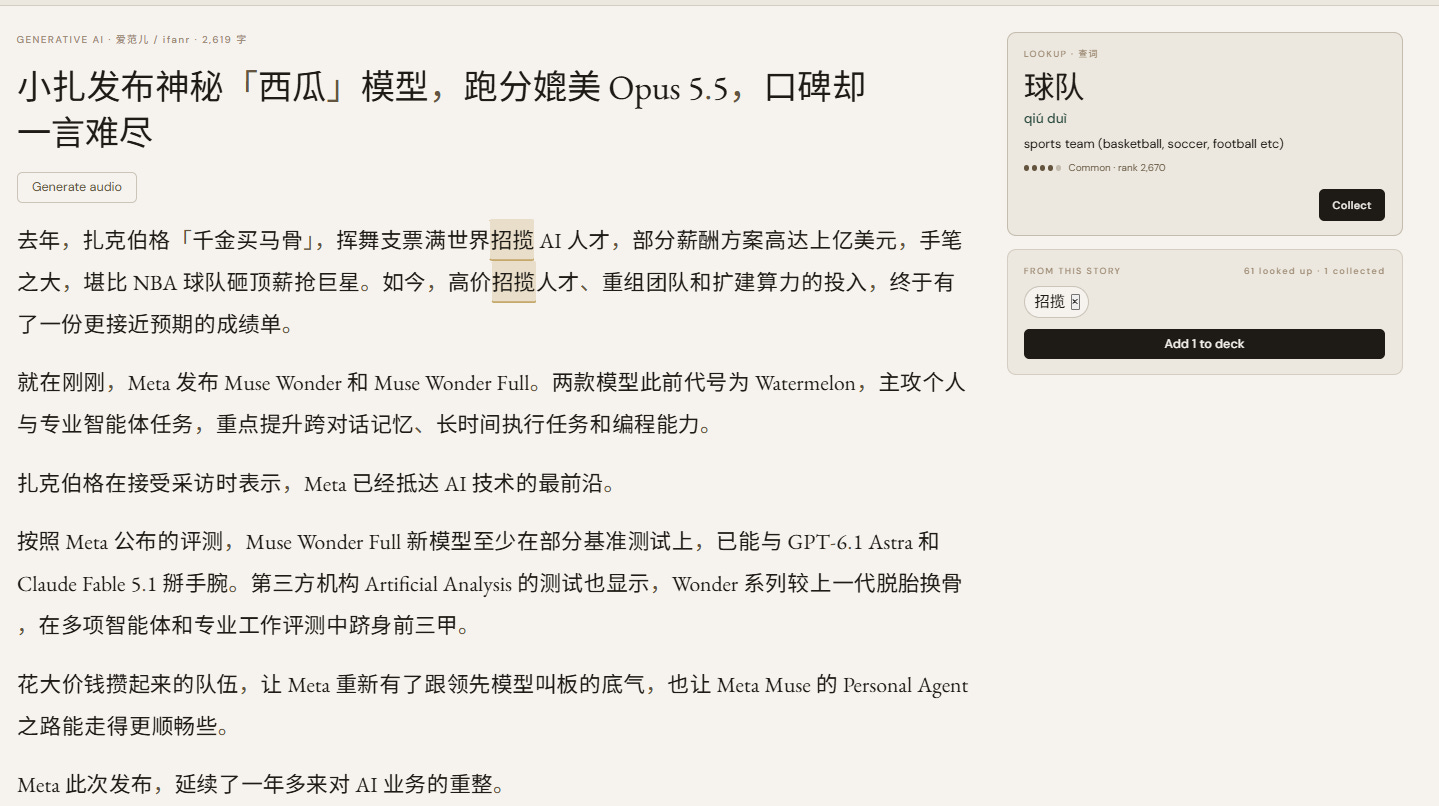
Example - My personal daily newspaper
Because the pieces were shorter and had a limited vocabulary range, my time shifted from study to practical application. Using words in context improved my flashcard retention rate from 56% in December 2025 to 87% as of this writing. When I went from spending 1 hour a day on flashcards to 20 minutes, I spent more time plugging knowledge gaps and was quickly able to read articles with less and less assistance. Now I regularly find and read articles that have direct impacts on my work, and I could have done so much earlier had I realized the need for this change.
2. Shape Your Exercises Around Your Learning Bottleneck
Once you prioritize what to learn, you need exercises that help you learn it. But keeping your current exercises in sync with your current needs requires you to continuously co-design new and updated exercises with your AI. I found the throughput optimization process outlined in The Goal the best way to put structure around this process - identify your learning bottleneck, hammer that bottleneck down until it is no longer your bottleneck, design new exercises around the next bottleneck, and measure what matters all along the way to ensure you are on the right track.
I started learning Mandarin by cobbling together exercises from osmosis and intuition, and initially used AI to accelerate these imperfect processes rather than reshape them to my precise needs. As most language students do, I took the tools everyone said were good (e.g. Mandarin Corner for listening practice) and intuited my way to a semi-functional set of exercises around those tools (e.g. listen to a word, handwrite it when you make a mistake, move on to the next word). After ChatGPT, I first used it to pump more content into this poorly intuited process (e.g. find more listening material).
It took until my fifth year of learning to realize AI could help me plug the holes that grew from my haphazard methods. I knew for a long time my listening routine was insufficient, but my Google and intuition-informed trial and error was just not fixing my ability to decode sounds into words in real time. Eventually I described my issues to Claude, and it found that an activity called shadowing (which I had never heard of) was the known cure to what felt like an obscure problem. We co-designed learning exercises, and after six weeks of practice I understood every word of a natural Mandarin sentence in real time for the first time.
This was my first true ‘wow’ moment with AI as a collaborative learning tool - I could finally do something I had aspired to for years on my own.
But then decoding sounds was no longer my bottleneck, so I designed new approaches to keep learning throughput high. I could recognize each sound as a distinct word as it came in, but I could not remember every word I had heard by the end of a longer sentence. I went back to the drawing board with Claude, rinsed and repeated the above process, co-designed new exercises, and worked until I had a new bottleneck. I applied this process to my reading and flashcards, and over time all my exercises were focused on exactly what I needed from them.
As I continuously evolved the system, I found it important to simplify and delete exercises. I quickly accumulated 15 activities in my daily learning schedule, which would have required 2-3 hours a day to finish every exercise. After reviewing my learning history with Claude, I decided to consolidate from 15 activities to 4 and redesigned my user interface to support those simplified needs.
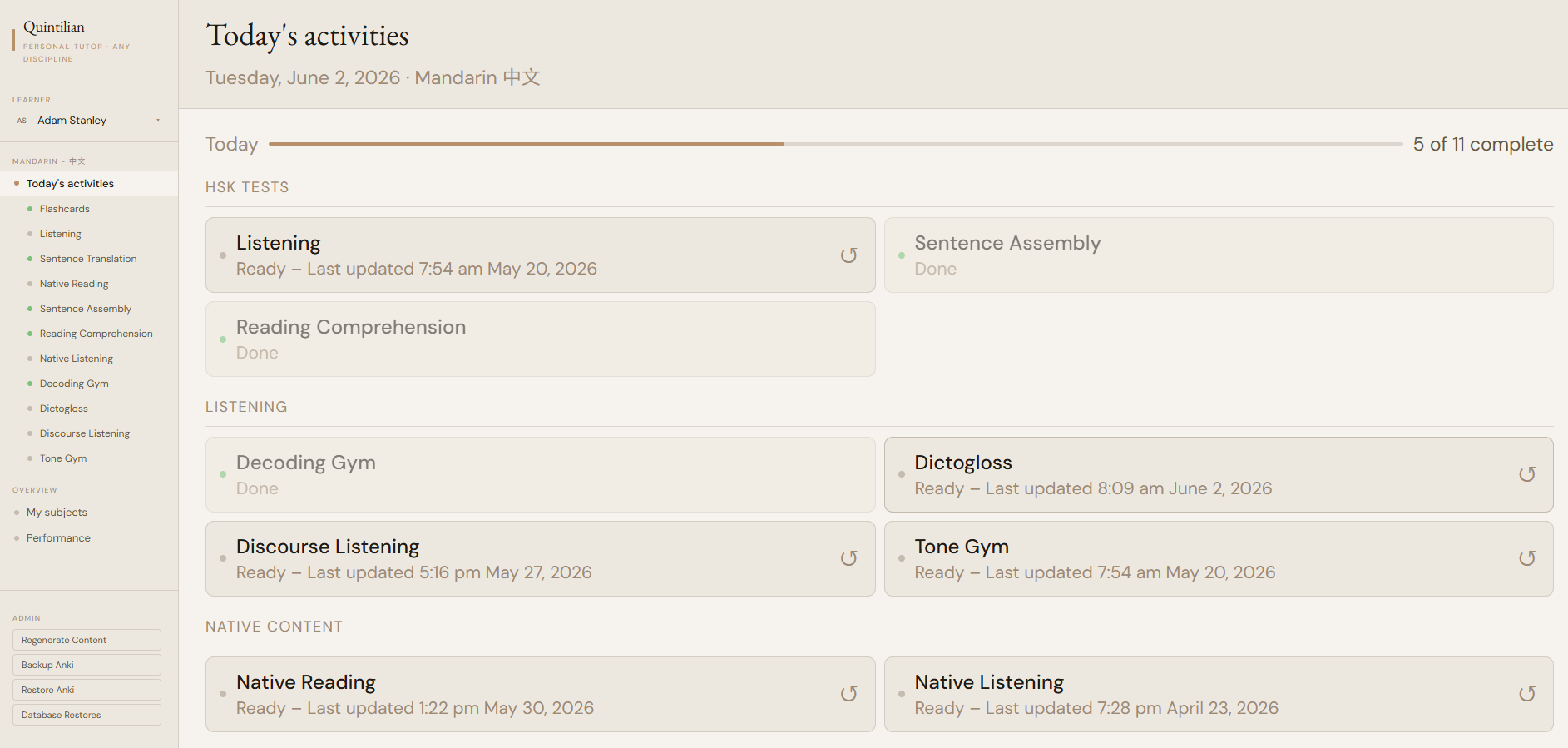
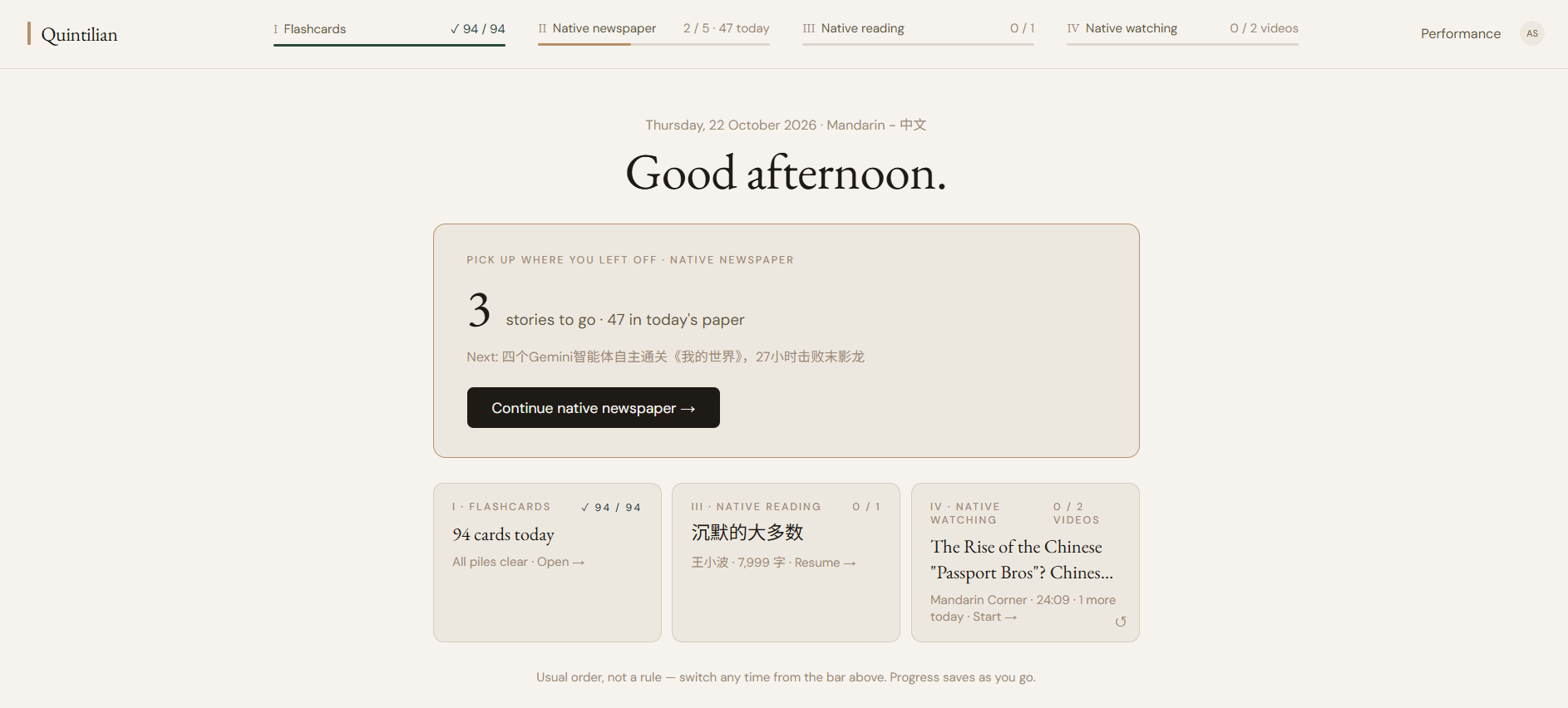
Old UI vs. Redesigned UI
The mistake that cost me the most time in this whole learning journey was not defining and tracking throughput metrics early on. For months after creating my learning platform, I tracked my progress mostly by loosely remembering how many mistakes I was making in exercises and asking Claude to review the data ad hoc if I felt like I was behind. The dashboards I have now make it painfully obvious that I had plateaued long before I intuited that my progress was flat, and that signal would have led me to take corrective action months or years earlier than I did.
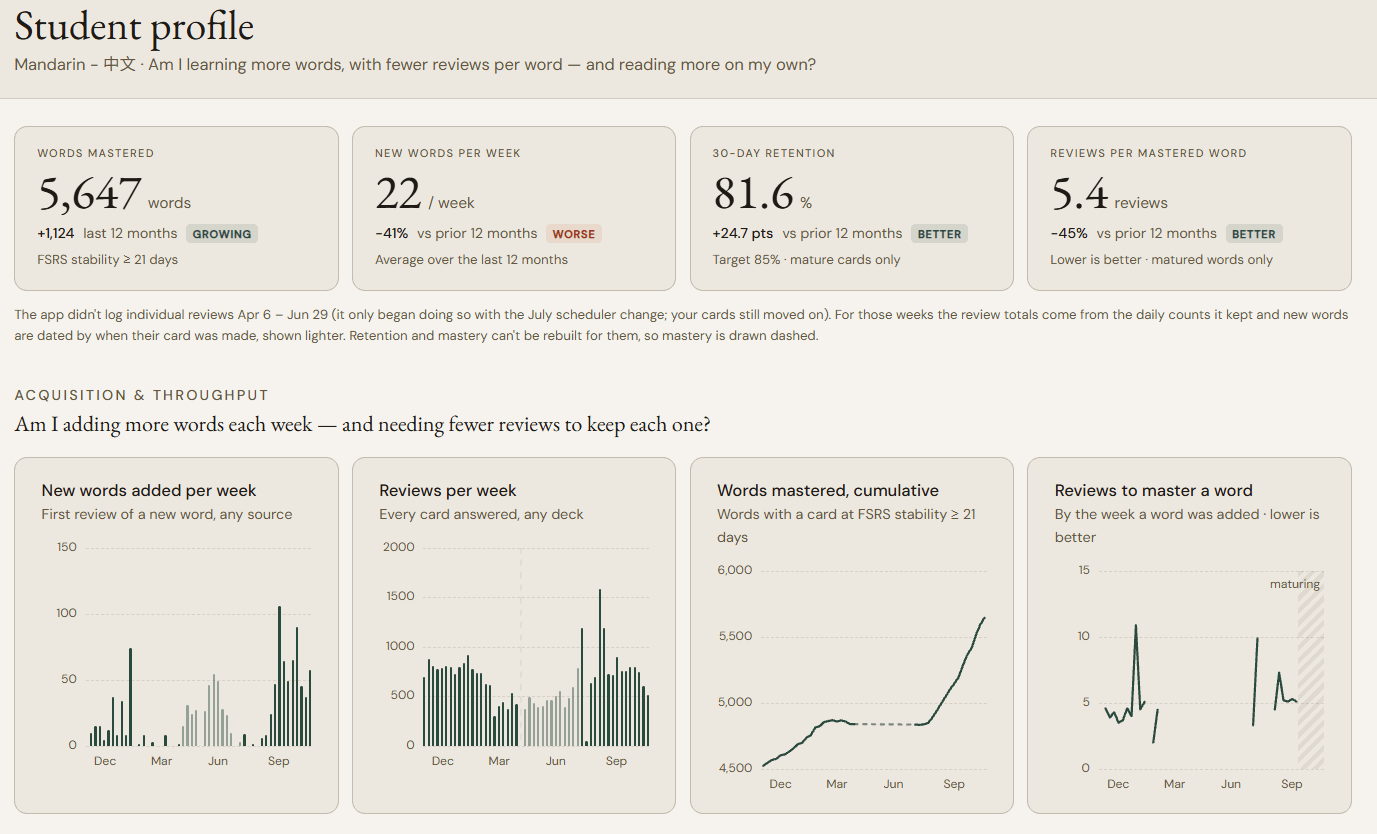
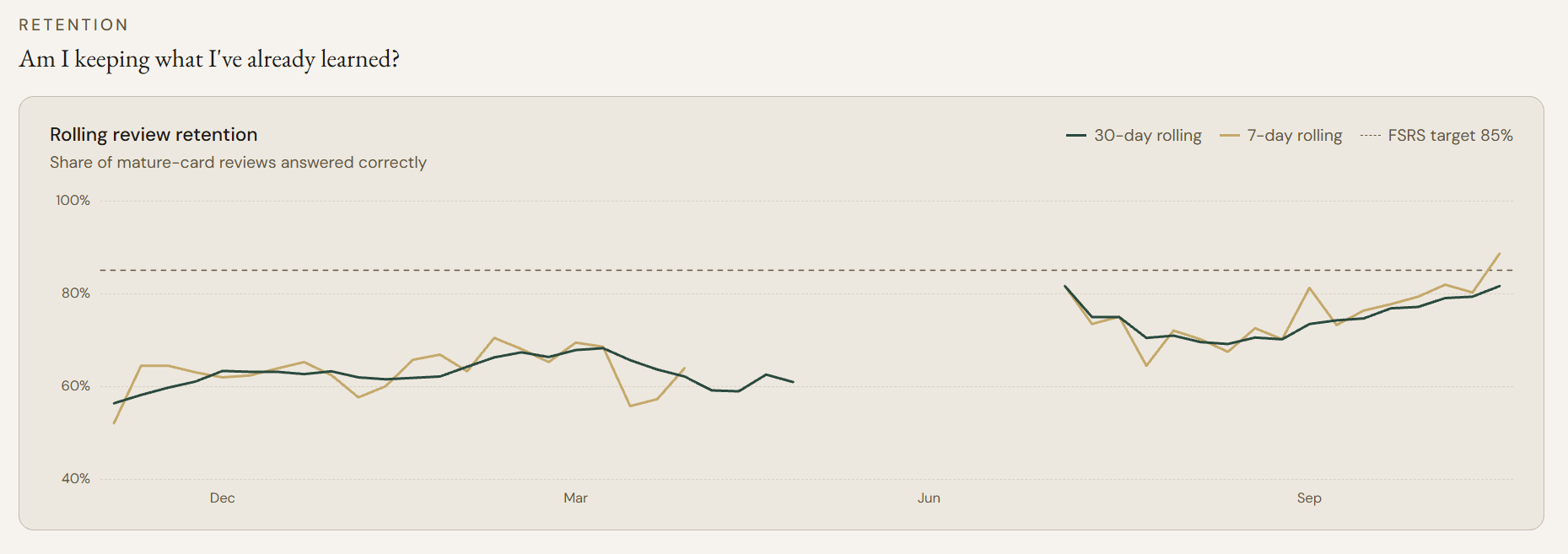
Learning Throughput Dashboard (data gaps due to application re-architecture interrupting tracking)
Concluding Thoughts
AI has blessed us all with expert instruction previously reserved for the top athletes of mainstream sports, but leveraging that instruction fully demands a top athlete’s level of ownership and agency over your learning journey.
You have a coach in your pocket that can use the best learning science to inform what exercises to do to maximize your learning the way LeBron has a team of humans to inform his exercises. But AI cannot make you better if you do not commit to using it in that way.
I believe AI will make anyone who asks capable of reaching new heights of personal knowledge, skill and flourishing, and I hope these lessons help you become one of those people.